
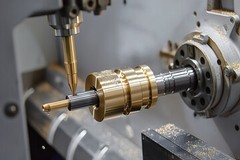
Some parts are so small and so precise that a fraction of a millimeter can mean the difference between a component that works flawlessly and one that fails. That level of accuracy is exactly where Swiss turning shines. If you have ever asked yourself what is Swiss turning and why it matters for modern manufacturing, you are in good company. It is one of the most reliable methods for producing tight-tolerance, high-volume components, and as a swiss screw machine shop in Chicago, we rely on it every day to deliver parts that meet demanding specifications.
In this guide, we will break down how the process works, where it came from, and why it remains a cornerstone of precision manufacturing. Whether you design medical devices, aerospace hardware, or intricate electronic connectors, understanding this technology can help you make smarter decisions about how your parts get made.
What Is Swiss Turning and Where Did It Come From?
Swiss turning is a machining process that produces small, complex, high-precision parts using a specialized lathe known as a Swiss-style or Swiss automatic lathe. The technology traces its roots to the Swiss watchmaking industry in the late nineteenth century, when manufacturers needed to produce tiny, accurate components for timepieces. That heritage of precision is still baked into the name and the process today.
So what is Swiss turning at its core? The defining feature is a sliding headstock and a guide bushing. Unlike a conventional lathe, where the workpiece is held at one end and extends outward, a Swiss lathe feeds the bar stock through a guide bushing positioned very close to the cutting tools. The material is supported right at the point of machining, which dramatically reduces deflection. That support is what allows the machine to hold exceptionally tight tolerances on long, slender parts that would flex and chatter on a standard lathe.
How the Swiss Turning Process Works
The mechanics behind Swiss turning are what set it apart. On a traditional lathe, the tool moves along the length of a stationary or fixed-position workpiece. On a Swiss machine, the material moves. The bar stock slides forward through the guide bushing while the cutting tools remain in a fixed axial position, engaging the material only a short distance from where it is firmly supported.
Because the cutting always happens right next to the guide bushing, the unsupported length of material stays minimal no matter how long the finished part is. This is the secret to machining small-diameter, high-aspect-ratio components without sacrificing accuracy. Modern CNC Swiss machines take this further by incorporating multiple tools, live tooling, and secondary spindles that perform milling, drilling, and cross-work in a single setup. A complex part can be turned, milled, threaded, and cut off in one continuous operation, which reduces handling and improves consistency from the first piece to the ten-thousandth.
To picture the workflow, here is a simplified look at how a part comes to life on a Swiss lathe:
- Bar stock is loaded and fed through the guide bushing.
- The material advances while stationary tools cut, drill, and mill the profile.
- Secondary operations happen on a back spindle without removing the part.
- The finished component is separated from the bar and the cycle repeats automatically.
Why Swiss Turning Delivers Superior Precision
The biggest reason manufacturers choose Swiss turning is the ability to hold extraordinarily tight tolerances repeatedly. When you are producing thousands of identical parts, consistency is everything. The guide bushing support minimizes vibration and deflection, so the last part in a run matches the first with remarkable fidelity.
Another advantage is the ability to handle long, thin, and intricate geometries. Slender shafts, pins, and fittings that would be nearly impossible to machine accurately on a conventional lathe are ideal candidates for the Swiss approach. Because so many operations are combined into a single cycle, cycle times drop and secondary handling errors are reduced. The result is higher throughput with less scrap, which is a meaningful benefit when part quality cannot be compromised. You can see examples of the kind of components this process produces in our manufactured parts gallery.
Materials and Industries That Rely on Swiss Turning
One of the strengths of Swiss turning is its versatility across materials. The process works exceptionally well with a wide range of metals and engineered plastics, each chosen based on the demands of the application. We routinely machine brass for connectors and fittings, along with stainless and alloy steels for structural and load-bearing components, and various plastics for lightweight, corrosion-resistant parts.
The industries that depend on these parts read like a cross-section of modern technology. Medical device makers need biocompatible components with microscopic tolerances. Aerospace and defense suppliers require parts that perform under extreme conditions. Electronics manufacturers rely on tiny connector pins and contacts. Automotive, telecommunications, and fluid-handling companies all turn to Swiss machining for components where reliability is not optional. The common thread is that when a part must be small, precise, and produced in volume, Swiss turning is often the smartest path.
Swiss Turning Versus Conventional Machining
It helps to understand when Swiss turning is the right choice and when a conventional lathe might suffice. Standard CNC turning is well suited to larger-diameter parts and shorter runs where extreme precision on slender features is not the priority. Swiss turning becomes the clear winner when parts are small, when length-to-diameter ratios are high, or when tight tolerances must be maintained across large quantities.
The economics also shift with volume. Setting up a Swiss machine involves careful tooling and programming, so the process delivers the most value on production runs where that investment is spread across many parts. For high-volume orders of complex small components, the per-part efficiency, reduced secondary operations, and consistent quality make Swiss turning both faster and more cost-effective over the life of the job. Choosing the right method from the start saves time, money, and frustration, and it is a conversation worth having with an experienced machine shop before production begins.
Getting High-Precision Parts Made Right
Understanding what is Swiss turning gives you a real advantage when planning a project. This process combines a century of precision heritage with modern CNC capability to produce small, complex parts that meet the most demanding specifications. From the guide bushing that supports the material to the multi-tool setups that finish a part in one cycle, every element of the technology is engineered around accuracy and repeatability.
For engineers and purchasing teams throughout Chicago and the surrounding areas, partnering with a shop that specializes in this discipline means fewer surprises and better parts. If you are evaluating a new component or looking to improve an existing one, our team offers swiss machining services in Chicago backed by decades of hands-on experience and a commitment to quality. You can learn more about our capabilities on our screw machine products page or reach out directly to discuss your project.
Precision matters, and the right process makes all the difference. When your parts demand tight tolerances, consistent quality, and dependable delivery, Swiss turning is a proven answer. Contact Precision-Tek Mfg. Inc. for a quote and let us show you how high-precision manufacturing can move your product forward.