
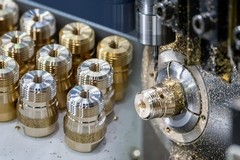
Few manufacturing processes can hold tolerances measured in ten-thousandths of an inch while producing thousands of identical parts, yet Swiss turn machining does exactly that every day. If you have ever wondered what is swiss turn machining used for, the short answer is that it excels at producing small, intricate, high-precision components that other methods struggle to match. As a swiss screw machine shop in the Chicago area, we see firsthand how this technology turns raw bar stock into complex parts for industries that cannot afford to compromise on accuracy.
The process traces its roots back to the Swiss watchmaking industry, where craftsmen needed to machine tiny, delicate components with extraordinary consistency. Today, that same principle powers modern manufacturing across medical, aerospace, electronics, automotive, and countless other sectors. Understanding where and why Swiss turning shines can help you decide whether it is the right fit for your next project.
How Swiss Turn Machining Works
Unlike a conventional lathe that holds the workpiece at one end and allows it to flex under cutting pressure, a Swiss-type machine supports the bar stock very close to the cutting tool through a guide bushing. The material slides through this bushing as it rotates, and the tools engage the work only a short distance from where it is supported. This design dramatically reduces deflection, which is the key reason Swiss machines can produce long, slender parts without sacrificing precision.
Because the cutting action happens so close to the support point, the process stays stable even on very small diameters. Multiple tools can work on the part simultaneously, and many machines feature live tooling that allows drilling, milling, and threading operations without moving the part to a second machine. The result is a finished component that often needs little or no secondary work, which keeps both lead times and costs in check.
What Is Swiss Turn Machining Used For in Real Applications
When people ask what is swiss turn machining used for in practical terms, the answer almost always involves small, complex parts made in volume. The medical device industry relies heavily on it for bone screws, surgical instrument components, dental implant parts, and other items where precision directly affects patient outcomes. These parts frequently combine tight tolerances with demanding materials such as titanium and stainless steel, both of which Swiss machines handle well.
Aerospace and defense manufacturers turn to Swiss machining for connector pins, fasteners, fittings, and sensor housings that must perform reliably under extreme conditions. In the electronics world, the process produces contacts, terminals, and miniature shafts in quantities that would be impractical any other way. The automotive sector uses it for fuel system components, valve parts, and precision fittings. Firearms, telecommunications, and industrial equipment manufacturers all depend on the same capabilities. The range of industries we serve shows just how broadly these parts reach into everyday products.
The Advantages That Set Swiss Turning Apart
The appeal of Swiss turn machining comes down to a combination of precision, efficiency, and versatility that is hard to find in a single process. Because the guide bushing keeps deflection to a minimum, the method holds exceptionally tight tolerances and produces smooth surface finishes even on challenging geometries. That accuracy stays consistent from the first part to the ten-thousandth, which matters enormously for customers who need every unit to be identical.
Efficiency is another major draw. With multiple tools engaging the work at once and secondary operations often completed in a single setup, parts come off the machine finished or nearly finished. This reduces handling, shortens production time, and lowers the overall cost per part on high-volume runs. A few of the benefits worth highlighting include:
- Tight tolerances and fine finishes on small, slender parts
- Reduced material deflection for greater dimensional stability
- Multiple operations completed in one setup, cutting lead times
- Excellent repeatability across large production quantities
- Compatibility with a wide range of metals and plastics
That last point deserves emphasis. Swiss machines work beautifully with materials ranging from stainless steel and titanium to softer options. We produce brass machined components in Chicago, IL and even engineered plastics, giving design engineers flexibility to choose the right material for each application without worrying whether the process can accommodate it.
When Swiss Turning Is the Right Choice
Not every part calls for Swiss machining, so it helps to recognize the situations where it truly outperforms the alternatives. Parts with small diameters, long length-to-diameter ratios, or intricate features benefit the most, since these are exactly the geometries that give conventional lathes trouble. If your design includes tight tolerances that must hold across a large batch, Swiss turning delivers the consistency you need.
Volume matters as well. The process is engineered for efficient, repeatable production, so it shines on medium to high quantity runs where the cost savings of single-setup machining add up quickly. When you combine complex geometry, demanding materials, and significant volume, the question of what is swiss turn machining used for answers itself. For a sense of the quality and variety we deliver, our manufactured parts gallery showcases components across many of these categories.
Materials and Finishing Considerations
One of the reasons customers keep coming back is the versatility Swiss turning offers in material selection. Hard metals like stainless steel and titanium are common in medical and aerospace work, while brass and aluminum see heavy use in electrical and plumbing components. Plastics round out the picture for applications where weight, insulation, or corrosion resistance take priority. Each material behaves differently under the tool, and experience plays a large role in dialing in the right speeds, feeds, and tooling to achieve a flawless result.
Finishing is another area where Swiss machining earns its reputation. Because the parts come off the machine with excellent surface quality, many require minimal post-processing. When additional finishing such as plating, anodizing, or heat treating is needed, starting with a precisely machined part makes every downstream step more reliable. Understanding what is swiss turn machining used for also means appreciating how it fits into the larger production workflow, reducing the chance of errors compounding across multiple operations.
Partnering With the Right Shop
Choosing a capable manufacturing partner makes all the difference between a frustrating project and a smooth one. The best results come from a shop that pairs modern equipment with experienced machinists who understand how to optimize a design for the process. That expertise shows up in better tolerances, smarter material recommendations, and fewer surprises during production.
Swiss turn machining remains one of the most effective ways to produce small, complex, high-precision parts at volume, and its advantages in accuracy, efficiency, and material flexibility continue to make it indispensable across demanding industries. Whether you are developing a new medical component or scaling up production of an electronic contact, the process offers a dependable path from concept to finished part. If you are looking for trusted swiss machining services and the surrounding communities, our team in Arlington Heights is ready to help you bring your project to life. Reach out for a quote and let us show you what precision manufacturing can do for your next run.