
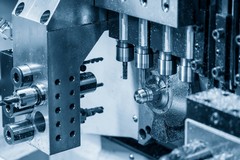
The technology behind some of the smallest, most precise metal parts in the world traces back to the Swiss watchmaking industry of the late 1800s. Watchmakers needed a way to produce tiny, exacting components in high volume, and the solution they developed still powers precision manufacturing today. If you have ever wondered what is a swiss machine and why it plays such an important role in modern production, you are asking a question that shapes decisions across aerospace, medical, electronics, and countless other fields. As a swiss machine shop in the Chicago area, we work with these machines every day and understand exactly why they continue to set the standard for accuracy.
Swiss machining is often misunderstood, sometimes confused with standard CNC turning or dismissed as a niche process. In reality, it is one of the most capable methods available for producing small, complex, tight-tolerance parts efficiently. This guide breaks down the fundamentals in plain language so you can understand how the technology works and when it makes sense for your project.
What Is a Swiss Machine and How Does It Work?
A Swiss machine, also called a Swiss-style lathe or Swiss-type screw machine, is a specialized turning machine designed to produce small-diameter, high-precision parts. The defining feature that sets it apart from a conventional lathe is the guide bushing. On a standard lathe, the workpiece is held by a chuck and extends outward, where it can flex or deflect under cutting pressure. On a Swiss machine, the bar stock is supported by a sliding guide bushing positioned very close to the cutting tools.
Because the cutting always happens right next to that guide bushing, the material has almost no opportunity to bend or vibrate. This is the secret to the exceptional accuracy Swiss machining is known for. Instead of the tool moving along the length of the part, the material itself feeds forward through the bushing while the tools stay fixed on the same axis. This arrangement keeps deflection to a minimum even on long, slender parts that would be nearly impossible to machine accurately any other way.
Modern Swiss machines are CNC controlled, meaning every movement is guided by precise computer programming. Many models feature multiple tool stations and both main and sub spindles, allowing a single machine to perform turning, drilling, milling, threading, and more in one continuous cycle. So when someone asks what is a swiss machine capable of, the honest answer is that it can often complete a finished part in a single setup that older methods would require several machines to produce.
Why Swiss Machining Matters for Precision Parts
The value of Swiss machining becomes clear when you consider the kinds of parts it produces. Think of components smaller than a pencil, with features measured in thousandths of an inch, that still need to fit and function perfectly. Medical implants, surgical instruments, connector pins, fasteners, and intricate shafts all fall into this category. These are parts where a tiny error is not a small problem but a complete failure.
Swiss machines excel at long, thin parts with a high length-to-diameter ratio. The guide bushing support means the machine can hold tight tolerances along the entire length of the part rather than only near the chuck. That reliability, combined with the ability to run parts continuously from bar stock, makes Swiss machining ideal for both prototype runs and large production quantities.
Another advantage is efficiency. Because a single machine can perform so many operations at once, parts move from raw material to finished product with far less handling. Less handling means fewer chances for error, faster turnaround, and more consistent quality across an entire batch. For manufacturers serving demanding industries, that combination is difficult to match.
Swiss Machine vs. Conventional CNC Turning
People new to the process often ask how Swiss machining compares to standard CNC turning. Both use computer control and both remove material to create precise shapes, but the differences matter depending on the part.
Conventional CNC lathes work very well for larger diameter parts and jobs where extreme slenderness is not a concern. They are versatile and widely available. Swiss machines, on the other hand, shine when parts are small, long, and require tight tolerances that would cause a standard lathe to struggle with deflection. The guide bushing is the fundamental difference, and it is why Swiss machining is the preferred choice for the miniature precision work that many industries depend on.
Cost and setup also differ. Swiss machines involve specialized tooling and programming expertise, so choosing the right process for the job is important. An experienced shop will evaluate the geometry, material, tolerance requirements, and volume of your part to recommend the most efficient approach. You can see the range of what these processes produce in our manufactured parts gallery, which shows the variety of components that come off precision equipment.
Materials Used in Swiss Machining
One of the strengths of Swiss machining is its flexibility with materials. The same fundamental process can be adapted to a wide range of metals and plastics, each with its own machining characteristics.
- Brass, prized for its excellent machinability and corrosion resistance, is common in fittings, connectors, and electrical components.
- Steel and stainless steel offer strength and durability for demanding structural and mechanical parts.
- Plastics allow lightweight, non-conductive, and chemically resistant components for medical and electronic uses.
- Aluminum, titanium, and various specialty alloys serve applications where weight, strength, or biocompatibility are critical.
The right material depends entirely on how the part will be used. A component destined for a corrosive environment has very different requirements than one built for high mechanical stress. If you want to dig deeper into specific options, our pages on brass part manufacturing explain how material choice influences the finished result and overall performance.
Who Relies on Swiss Machined Parts?
Once you understand what a Swiss machine does, it becomes easier to recognize just how many products depend on it. The medical device industry is a major user, relying on Swiss machining for bone screws, dental components, and surgical tools where precision is non-negotiable. The aerospace and defense sectors use these parts for connectors, sensors, and hardware that must perform flawlessly under extreme conditions.
Electronics manufacturers depend on Swiss machined pins, contacts, and housings, while the automotive industry uses them for fuel system components, sensors, and small precision fittings. Across Chicago and the surrounding areas, companies in these fields turn to Swiss machining when standard methods simply cannot hold the required tolerances at scale. That is the real answer to what is a swiss machine used for: it produces the small, essential parts that keep critical products working.
Bringing Precision to Your Next Project
Swiss machining combines a clever engineering principle, the guide bushing, with modern CNC control to produce small, complex parts with remarkable accuracy. It outperforms conventional turning for slender, tight-tolerance components, handles a broad range of materials, and delivers consistent quality across both prototypes and full production runs. Understanding what is a swiss machine helps you make smarter decisions about how your parts should be manufactured and which process truly fits your needs.
Whether you are developing a new medical device, sourcing precision electronic components, or scaling up production of an existing part, choosing the right manufacturing partner makes all the difference. Our team serves manufacturers throughout Chicago and neighboring communities with the expertise and equipment to bring demanding designs to life. To learn more about our capabilities or to discuss your project, reach out for a quote and let us help you build parts that meet the highest standards of precision.