
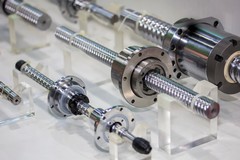
When a linear motion system drifts off target or a machine axis stutters under load, the culprit is often the component doing the heavy lifting: the lead screw. These unassuming threaded shafts translate rotary motion into linear travel, and the quality of that translation depends entirely on how carefully the screw was made. As a swiss machine shop in the Chicago area, we see firsthand how precision made lead screws can be the difference between equipment that performs reliably for years and equipment that demands constant adjustment.
Lead screws may look simple, but they operate in a world measured in thousandths of an inch. A slightly out of round profile, an inconsistent thread pitch, or a rough surface finish can introduce backlash, wear, and positioning errors that compound over time. That is why performance truly starts at the component level, long before the screw is ever installed.
Why Component Quality Defines Lead Screw Performance
A lead screw does not operate in isolation. It works with a nut, bearings, and a motor to move loads with repeatable accuracy. If the screw itself carries even minor imperfections, every part of that system has to compensate. Inconsistent thread geometry creates uneven contact between the screw and nut, which accelerates wear and shortens service life. Surface irregularities increase friction, waste energy, and generate heat that can affect nearby components.
Precision made lead screws solve these problems at the source. When the thread form is cut and finished to tight tolerances, the mating nut engages smoothly across its entire length. That means consistent torque, predictable travel, and far less backlash. For applications where positioning accuracy matters, such as medical devices, automation equipment, and measuring instruments, this level of consistency is not a luxury. It is a requirement.
The Role of Swiss Machining in Lead Screw Manufacturing
Not every machining method is suited to producing long, slender, high accuracy parts. Lead screws present a particular challenge because their length to diameter ratio makes them prone to deflection and chatter during machining. This is where Swiss style turning earns its reputation. By supporting the workpiece close to the cutting tool through a guide bushing, Swiss machines minimize vibration and maintain exceptional dimensional stability along the full length of the part.
That stability is exactly what precision made lead screws demand. The result is a thread profile that stays true from end to end, with surface finishes that reduce friction and promote smooth engagement. Our team in Arlington Heights, IL has built its process around this capability, serving customers throughout Chicago and the surrounding areas who need components that hold up to real world demands.
Material Selection Matters More Than You Think
The right material is just as important as the right machining method. Lead screws are manufactured from a range of metals and engineered plastics, and each choice carries tradeoffs in strength, wear resistance, corrosion resistance, and cost. Stainless steel offers durability and resistance to harsh environments. Carbon steel delivers strength at a lower cost. For lighter loads or applications where quiet, self lubricating motion is valued, engineered plastics and brass components can be ideal.
Choosing well requires understanding how the finished part will be used. A screw destined for a food processing line faces different pressures than one driving a camera positioning stage. We regularly work with customers to match material to application, whether that calls for our brass part manufacturing or the lightweight, low friction benefits of engineered plastics. Getting this decision right early prevents costly failures later.
How Tolerances Translate Into Real World Reliability
Tolerance is the quiet hero behind every dependable lead screw. It defines how much a dimension is allowed to vary from its target, and tighter tolerances mean more predictable behavior. When a lead screw holds its pitch accuracy tightly, the nut travels exactly the expected distance for each rotation. That predictability is what allows automated systems to position parts correctly thousands of times without drift.
Loose tolerances introduce lead error that accumulates with each turn. In a short travel application that may be tolerable, but over longer distances or high cycle counts, those small deviations add up to significant positioning problems. Precision made lead screws are manufactured and inspected to keep these errors within specification, which is why documented quality control is such an important part of serious manufacturing. The goal is not just a part that works out of the box, but one that keeps working consistently over its full service life.
What to Look for in a Lead Screw Manufacturing Partner
Choosing who makes your components is as consequential as the components themselves. A capable partner brings more than machines to the table. They bring engineering insight, quality systems, and the willingness to understand your application before quoting a job. When you evaluate a manufacturer, a few qualities separate the dependable from the merely available:
- Proven experience with long, slender, high tolerance parts rather than only simple turned components.
- In house inspection and quality control that verifies thread accuracy, surface finish, and dimensional consistency.
- Material versatility across metals and plastics so your design is not forced to fit a limited capability.
- Clear communication and responsiveness, so revisions and questions do not stall your project.
These factors matter because a lead screw is rarely a one time purchase. Reorders, scaling, and design refinements are part of most product lifecycles. A manufacturer who understands your part the first time saves you time on every order after. Our industries served span automation, medical, and beyond, giving us perspective on how different sectors stress their components.
Precision Pays Off Over the Life of Your Equipment
It can be tempting to view lead screws as commodity parts and to shop on price alone. But the true cost of a component reveals itself over time. A poorly made screw that introduces backlash, wears quickly, or fails under load can trigger downtime, warranty claims, and customer dissatisfaction that far exceed any savings at the point of purchase. Precision made lead screws, by contrast, earn their keep through years of reliable service and reduced maintenance.
That is the philosophy behind everything we do. We believe performance starts with the component, and that getting the fundamentals right, the material, the machining method, and the tolerances, produces parts our customers can trust. Whether you are prototyping a new design or scaling an established product, partnering with a shop that treats precision as a standard rather than an upgrade changes what your equipment is capable of.
If you are evaluating swiss machining services in Chicago and nearby communities, we would welcome the chance to discuss your project. Reach out for a quote or to talk through your requirements, and let our team help you build components that perform from the very first turn.