
Some of the smallest parts in the world carry the biggest responsibilities. Tiny threaded fittings, connector pins, medical components, and intricate shafts often measure just a few millimeters across, yet they must hold tolerances tighter than the width of a human hair. Producing them reliably takes specialized equipment, and that is exactly where Swiss screw machines earn their reputation. As a swiss machine shop in the Chicago area, we field one question more than almost any other from customers and curious visitors alike: how do swiss screw machines work, and what makes them different from standard turning equipment?
The short answer is that Swiss machining supports the workpiece in a fundamentally different way, which allows it to cut long, slender, and highly detailed parts with remarkable stability. The longer answer is worth exploring, because understanding the technology helps explain why so many industries rely on it for their most demanding components.
The Origins of Swiss-Style Turning
The design traces back to the Swiss watchmaking industry, where craftsmen needed to produce tiny, precise pins and screws by the thousands. Traditional lathes struggled with such small, delicate work because the cutting forces would flex the material and ruin the tolerances. Swiss engineers solved the problem with a sliding headstock and a guide bushing, a combination that changed precision manufacturing forever.
Although the technology now runs on advanced CNC controls rather than hand-operated cams, the core principle remains the same. The workpiece is held and guided very close to the cutting tool, which keeps it steady and virtually eliminates the deflection that limits conventional lathes. That heritage of precision is still the standard we hold ourselves to today.
How Do Swiss Screw Machines Work
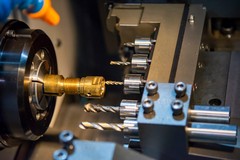
To really answer how do swiss screw machines work, it helps to picture the material and the tools rather than the machine housing. A long bar of raw stock, whether brass, steel, or plastic, is fed through a rotating spindle. Instead of the tool moving down the length of the part while the material stays fixed, the material itself slides forward through a guide bushing positioned right next to the cutting tools.
Because the guide bushing supports the bar so close to where the cutting happens, the section being machined is always braced against bending. The cutting tools remain stationary in the Z-axis and move in to shape the part as fresh material advances. This is the key distinction: the part is machined at its strongest, most supported point at all times. That stability is what allows Swiss machines to cut features that would cause a standard lathe to chatter, taper, or flex out of tolerance.
Modern Swiss CNC equipment adds even more capability. Multiple tools can work on the part simultaneously, and secondary spindles allow operations on both ends of a component without removing it from the machine. A single setup can turn, drill, mill, thread, and knurl a finished part, which reduces handling and preserves accuracy from start to finish.
Why the Guide Bushing Changes Everything
If there is one component that defines Swiss machining, it is the guide bushing. On a conventional lathe, the further the material extends from the chuck, the more it wants to deflect under cutting pressure. That deflection is the enemy of tight tolerances, and it grows worse as parts get longer and thinner.
The guide bushing eliminates that unsupported length. Since the material is held rigidly right where the tool meets it, the machine can produce long parts with slim diameters while maintaining consistent dimensions from one end to the other. This is why Swiss turning is the go-to method for components with high length-to-diameter ratios, such as pins, shafts, and threaded fasteners. It also produces excellent surface finishes, because the reduced vibration leaves cleaner cuts behind.
The Materials Behind Precision Parts
Not every material behaves the same way under a cutting tool, and part of skilled machining is matching the process to the metal or polymer at hand. Swiss machines handle a broad range of stock, and the choice usually comes down to the part's function, environment, and cost considerations.
- Brass: Prized for its machinability and corrosion resistance, brass is a favorite for fittings, electrical components, and fluid-handling parts. You can learn more on our brass part manufacturing page.
- Steel and stainless steel: Chosen for strength and durability, steel is common in fasteners, shafts, and structural components that must endure heavy use.
- Plastics: Lightweight and often chemically resistant, engineered plastics work well for insulating parts, medical components, and applications where metal is not ideal.
Each material calls for different tooling, speeds, and coolant strategies. A machine shop's experience shows in how it adapts the process, because the same part can succeed or fail based on how well the setup accounts for the material's behavior.
Industries That Depend on Swiss Machining
The precision and repeatability of Swiss turning make it valuable far beyond the watch industry where it began. Medical device manufacturers rely on it for surgical components and implantable hardware. The aerospace and automotive sectors use it for connectors, sensors, and safety-critical fasteners. Electronics companies need the tiny pins and contacts that keep modern devices working.
What ties these fields together is a demand for consistency at scale. When a customer needs tens of thousands of identical parts, all within the same exacting tolerance, Swiss machining delivers. That reliability is why manufacturers across Chicago and the surrounding communities turn to shops equipped for this kind of work. You can see the range of sectors we support on our industries served page.
Precision, Volume, and Repeatability
One of the most valuable aspects of Swiss screw machines is how well they combine speed with accuracy over long production runs. Once a program is dialed in, the machine can run continuously, producing part after part with minimal variation. Bar feeders keep the process fed with material, allowing extended unattended operation and efficient throughput.
This repeatability is not just about volume. It means the ten-thousandth part matches the first, which is essential when components have to fit into larger assemblies without adjustment. For engineers and buyers, that predictability reduces waste, simplifies quality control, and keeps projects on schedule. When people ask how do swiss screw machines work so consistently, the answer lies in this blend of rigid support, multi-tool efficiency, and precise CNC control working together.
Bringing It All Together
Understanding how do swiss screw machines work reveals why they remain the standard for small, complex, high-tolerance parts. The sliding headstock and guide bushing keep material supported exactly where it is cut, eliminating the deflection that limits ordinary lathes. That single design idea enables long slender parts, superb finishes, and the tight repeatability that critical industries require. Add modern CNC control and multiple simultaneous operations, and you have a process built for both precision and productivity.
For anyone weighing the best way to produce demanding components, the takeaway is straightforward. When your parts need consistent quality across large runs and features too fine for conventional turning, Swiss machining is the technology worth considering. The right material, the right setup, and experienced operators make all the difference in the finished result.
If you have a project that calls for precision turned parts, we would be glad to talk it through. Explore what we do to see our capabilities, and reach out to our team in Arlington Heights to request a quote or get answers about your specific application. Precision-Tek Mfg. proudly serves manufacturers throughout Chicago and neighboring towns with the expertise these parts deserve.