
Brass has been prized for thousands of years, from ancient coins and musical instruments to the precision components that keep modern machinery running. Its warm golden tone is only part of the appeal. What makes brass so valuable to engineers and manufacturers is its blend of strength, corrosion resistance, and remarkable machinability. If you have ever wondered exactly how is brass manufactured, the answer involves a fascinating series of steps that transform humble raw ores into refined, workable metal. As a swiss screw machine shop in the Chicago area, we work with brass every day, so we understand both the science behind the alloy and the craft of turning it into finished parts.
Understanding the production process helps buyers and engineers make smarter decisions about material selection, tolerances, and finishing. Whether you are sourcing fasteners, fittings, or custom turned components, knowing where your metal comes from gives you a clearer picture of quality and performance.
What Exactly Is Brass?
Brass is not a naturally occurring metal. It is an alloy, meaning it is created by combining two or more elements. In this case, the primary ingredients are copper and zinc. By adjusting the ratio of these two metals, manufacturers can produce dozens of distinct brass varieties, each with its own characteristics. A higher copper content generally yields a softer, more corrosion-resistant metal, while more zinc increases strength and hardness.
Small amounts of other elements are often added to fine-tune the alloy for specific uses. Lead, for example, has traditionally been added to improve machinability, which is why free-machining brass is so popular in high-volume production. Tin boosts corrosion resistance in marine environments, and aluminum can add strength. These subtle recipe changes are a big reason brass remains one of the most versatile metals in the manufacturing world.
How Is Brass Manufactured From Raw Materials?
The journey begins with the extraction and refining of copper and zinc. Copper is mined from ore, then smelted and electrolytically refined until it reaches high purity. Zinc goes through its own refining process, often involving roasting and electrolysis. Once both base metals are ready, the actual alloying can begin.
To answer how is brass manufactured at the foundry level, copper is melted first because it has a much higher melting point than zinc, roughly 1,085 degrees Celsius compared to zinc's 420 degrees. Once the copper is molten, carefully measured amounts of zinc are introduced. Timing matters here, because zinc can vaporize if added too early or at the wrong temperature. Skilled metallurgists control the furnace atmosphere and temperature to ensure the zinc fully blends into the copper without excessive loss.
After the metals are combined into a uniform molten mixture, the brass is cast. Depending on the intended end use, it may be poured into molds to create ingots or formed into continuous shapes through continuous casting. These solidified forms become the starting point for the next stages of shaping.
From Cast Metal to Usable Shapes
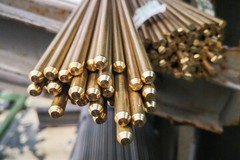
Raw cast brass is rarely used as is. Instead, it undergoes mechanical processing to achieve the dimensions and properties that fabricators need. Hot working is often the first step, where the brass is heated and then rolled, extruded, or drawn into sheets, rods, tubes, or wire. Extrusion is especially common for producing the long brass rods that feed precision machining operations.
Cold working follows in many cases. Drawing the metal through dies at room temperature improves its strength and surface finish while tightening dimensional tolerances. Between these forming steps, manufacturers frequently apply annealing, a controlled heating and cooling process that relieves internal stresses and restores ductility. This careful balance of working and annealing is central to understanding how is brass manufactured into forms that machine shops can rely on.
By the time brass reaches a production facility as bar stock, it has already been engineered for consistency. That consistency is critical, because the quality of the incoming material directly affects the quality of the finished part.
Turning Brass Into Precision Parts With a Screw Machine
Once brass arrives as rod or bar stock, it is ready for machining. This is where the alloy's excellent machinability truly pays off. A screw machine is designed to produce high volumes of small, precise turned components with speed and repeatability. Brass feeds beautifully through these machines, producing clean chips and smooth surface finishes while allowing fast cutting speeds that keep production efficient.
Modern Swiss-style screw machines take this precision even further. In Swiss machining, the bar stock is supported by a guide bushing very close to the cutting tools, which minimizes deflection and allows extremely tight tolerances on slender, intricate parts. This makes the process ideal for components used in electronics, medical devices, plumbing, automotive systems, and countless other applications. You can see examples of the kinds of components we produce through our brass part manufacturing in Chicago, IL.
Brass responds so well to this process that it is often a first-choice material when a project calls for both precision and cost efficiency. The combination of a reliable alloy and well-maintained equipment means manufacturers can hold consistent quality across thousands or even millions of parts. When you understand how is brass manufactured and refined before it ever reaches the lathe, it becomes clear why material quality and machining expertise go hand in hand.
Why Material Quality Matters for the Finished Product
Not all brass performs the same way under machining. Variations in zinc content, impurities, or inconsistent annealing can lead to problems like poor surface finish, difficult chip formation, or dimensional drift. That is why experienced shops pay close attention to material sourcing and verification. A part is only as good as the metal it is made from, and the upstream manufacturing choices ripple all the way through to the customer's hand.
Finishing operations often follow machining to enhance performance or appearance. These may include deburring, plating, polishing, or passivation depending on the application. Brass naturally resists corrosion, but additional finishes can improve conductivity, wear resistance, or aesthetics. Throughout every step, careful inspection ensures that each component meets its required specifications.
For companies that need reliable, high-volume turned components, partnering with experienced screw machine shops in Chicago makes a real difference. Our work supports manufacturing applications across a variety of industries. The right manufacturing partner understands not only the machining itself but also the metallurgy behind the material, which helps prevent costly surprises down the line.
Bringing It All Together
So, how is brass manufactured from start to finish? It begins with mining and refining copper and zinc, continues through precise alloying and casting, moves on to hot and cold working that create usable rod and bar stock, and finishes with precision machining that transforms raw metal into functional parts. Each stage builds on the last, and quality at every step determines how well the final component performs.
At Precision-Tek Mfg. Inc. in Arlington Heights, we take pride in turning high-quality brass into components that meet demanding specifications for customers throughout Chicago and the surrounding communities. If you are looking for dependable swiss machining services in Chicago, our team is ready to help you move from concept to finished part with confidence.
Whether your project calls for brass, stainless steel, or engineered plastics, we invite you to reach out for a quote. Understanding the metal is just the beginning. Partnering with an experienced shop is how great parts get made.